Showing posts with label Malaysian. Show all posts

Saturday, 22 May 2010

Kuih Kodok


Went for a 2D/1N trip straight after krok. So the balanced bananas were stuffed into the fridge. When I was back, they are slightly darkened I doubt I could eat it just like that. So came out with this sweet Malaysian Mashed Banana Fritters = Kuih Kodok. Reminding myself that I have about 2 months till I am back in Malaysia for good ... ... Hmm, how I miss Malaysian food!

Look at the consistency inside, looks just like banana cake, but the mini fried version :P

Ingredients :
2 large riped bananas
1 cup flour
1 sharp tablespoonful of sugar
1 teaspoon bicarbonate soda
1 teaspoon salt

Left : Mashed Bananas
Right : Mashed bananas after mixing with other ingredients
Methods :
1. Mashed the bananas with a fork in a bowl.
2. Add in the rest of the ingredients and mixed well.
3. Heat oil in a pot.
4. Take a spoonful of the batter and drop it in the oil (medium heat).
5. It will float when it is done.

Even the Kuih Kodok knew that ... ...

I always cook with love and care :P

Saturday, 1 May 2010

Kuih Leper

Ok ok...look at it properly...it's not "leper" as in leprosy. It's a malay word known as Leper, meaning flat. Kuih leper doesn't exist, as far as I am concern. But today kuih leper will exist, because of me hahaha. I self-named my new-found kuih as Kuih Leper ... ta-ta-ta-daa
Today is Labours' Day (Yeah, 1st of May). I wanted to do Kuih Bom (a fried round kuih coated with sesame with the nuts/coconut filling), but sad to say...failed to. I don't know why but I just couldn't wrap it properly. The dough just melted off and became so sticky that I can't even rolled it. So I actually threw away 2 "balls". Then I just don't know what to do with the balance of the dough and filling. So I came up with "Just fry them, don't care!" So here it is ---> Kuih Leper!!! Happy frying.

Ingredients :
Oil to fry

A)
40g Corn Starch
40g Hot Water
B)
200g Glutinous Rice Flour
50g Flour
50g Castored Sugar
1 teaspoon salt
2 tablespoons salt
Water (sufficiently to form the dough)
C)
100g Grated Coconut
150g Gula Melaka (chopped a bit)
3 tablespoons sugar
1/2 teaspoon salt
50ml water
Method :
1. Prepare (A). You will get something sticky just like in the picture above.
2. Prepare (B). Form a dough.
3. Mixed the doughs in (1) & (2). So you will get one dough now.
4. Heat pan/pot with oil.
5. Pull a small portion of the dough, make a small ball, flatten it.
6. Put it in the hot ol, fry with low fire, till golden brown, like the picture below.
7. For (C) --- The filling : In a pot, fill in with the water, pour in Gula Melaka and melt it.
8. Then add sugar (more if you want it sweeter or less) and salt.
9. Add in the shredded coconut, mix together (Don't burnt it :D)
10. Serve with the Kuih Leper.

The result of the filling
Then what I did with the balanced oil??? See?
Hehehe, keropok! Hmm, I love this a lot a lot a lot!!!

Sunday, 18 April 2010

Stew Pork With Shitake Mushroom

Have too much of Shitake mushroom, and don't know what to do with it in less than two months? This is what I have come out with. But of course if you don't have, Shitake mushroom, you can get it almost anywhere. For people in Simferopol, you can get them in the central market, some stalls selling "limited" Asian ingredients or in Metro occasionally.

Ingredients :

800g of Pork (In big pieces , preferably...and with some fats??)
10 small (5 if big) Shitake Mushroom (Soaked in hot water till soften)
5 cloves of Garlic (chopped)
100g of Ginger (Sliced)


Marinate pork for an hour or two with :
2 teaspoons Five Spice Powder
3 tablespoons Light Soy Sauce
A dash of pepper
1 tablespoon Sesame Oil

Additional Seasoning :

a) 2 tablespoon Dark Soy Sauce
b) 3 tablespoons Light Soy Sauce
c) 1 tablespoon Oyster Sauce
d) 4 or 5 tablespoons Sugar
e) A pinch of Pepper
f) 1-1.5 teaspoons Salt


Method :
1. Add 2-3 tablespoons of oil in pan.
2. Sauté garlic , then add ginger.
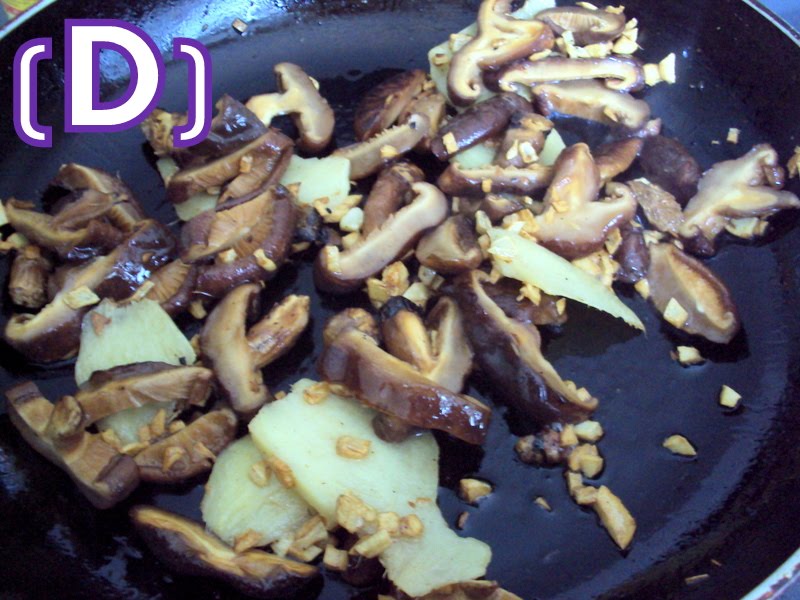
3. Add sliced Shitake mushroom, continue to sauté (Pic D).
4. Add pork.
5. Add (a-c) then add (d).
6. Add hot water just like in picture F.
7. Transfer into a pot and add hot water to simmer with low fire until meat is tender (Pic G).
8. Stir once in a while and also add water if it dries up before meat is tender.
9. When meat is tender, add (e & f). Then, allow the water to thicken a bit into gravy-like.
10. Serve with rice and fresh sliced cucumber

P/S : Ah Bear (the super chef) said hor, that after I finish cooking and cleaning up, right, there is still trace of fragrance left in the kitchen. Not trying to show off...but I can't keep to be happy hehehe

Super Thickened gravy-like (Because I forgot to check on it :P)
I actually prefer it with a little bit more sauce

Saturday, 17 April 2010

Kuih Lobak


Kuih Lobak a.k.a Lo Bak Ko is made of Daikon. I happened to have a small daikon in the fridge. And it has been staying in there for about 2 weeks. I gotta get an idea to clear it. And then sprang an idea of making Lo Bak Ko.

After browsing the net for quite some time, I reached upon this page of LilyWai's. I modified the recipe though. I omitted the Chinese sausage and tung min flour. And because of my small daikon, I recalculated the portions.


Ingredients :
300g daikon (shredded)
1 Onion (sliced)
30g Udang Kering
50g Shitake Mushroom
20g Corn Starch
100g Rice Flour (not glutinous rice flour!)
300ml Hot Water

Seasonings :
1 tsp salt
1 tsp sugar
1 tsp sesame oil
A dash of pepper

Method :
1. Soften the dried shrimps with some water in a bowl. Then slightly chop it.
2. Cut the Shitake mushrooms into cubes after softening it with hot water.
3. Place rice flour and corn starch in a bowl. Pour 300ml of hot water into the bowl and stir well. It will be glue-like.
4. Grease a pan with some oil.
5. Heat up small amount of oil in a pan fry onion (then set aside),
6. Fry the dried shrimp, then set aside again.
7. Followed by mushroom (set aside). Finally , the shredded radish and then set aside again.
8. Mix all the "set aside" ingredients (4 in total) and season with the seasoning ingredients.
9. Pour (8) in the pan and pour the flour mixture into the pan. Cook until the mixture thickens.
10. Place the thick batter into the greased pan prepared earlier.
11. Steam at high fire for about 1 hour.
12. Slice the Lo Bak Ko only when it is cooled down.
*You may fry it after it is cooled down too (picture below)*

Some mistakes I made:
My mistake in doing this is that I didn't set aside those ingredients, so you can see that mine turn out brownish instead of a whiter color. The second mistake is that my batter wasn't too thick, so it turn out a bit too soft. Third, I added too much of salt (miscalculated), but the recipe I wrote was corrected (I also forget that the dried shrimp is already quite salty :P ) Fourth, I thought my batter is thick enough, I should have waited it too be even thicker before steaming :(

Other than that, I think the taste of my Kuih Lobak is fine (except the salty part hahaha). One more thing, personally, I think if I changed my recipe with 500g Daikon, 150g rice flour and 500ml water, it should turn out even better.

Serve the Kuih Lobak with chilly sauce or maybe sambal :)


After frying

P/S :
This is what I did with the unfinished super duper salty Kuih Lobak ---> Fried Rice :D

Monday, 12 April 2010

Vegetarian Cucur

11th April 2010 was second Easter Sunday in the Catholic calender. Father Christopher's (or maybe now Father Thomas??? :P) birthday is on the 14th April. But about 3 weeks ago, Sister Magdeline suggested a surprise Easter+Birthday celebration on the 11th April. Brilliant. I still remember when we arrived in the church placing the food in the kitchen, the way Father Christopher was surprised. That's funny.

This time, I prepared a cucur, vegetarian one. It's simple. But I don't understand why my mum managed to have crispy ones, yet mine is soft when it is cool. Anyway, the recipe is below. It's super easy and low cost, just time consuming for the frying part. And perhaps a little unhealthy?! Hehehe.


In Malaysia, you can easily find Cucur Udang (with prawns) especially in Indian Rojak. My mum usually does with small fresh prawns (without the shells and head) and it is not as thick as mine. It's more thin and crunchy. She also loves to do cucur with the Dried Ikan Bilis (Dried Anchovy) & cilantro. Hope you enjoy this simple recipe :D

Ingredients :
Flour
Water
Salt
Onion (sliced thinly)
Shredded Carrot
Oil
P/S : You may add corns or spring onion or anything of your choice.

Method :
1. Prepare batter with flour and water. The batter should be as the consistency of the batter for pancake. Make sure there isn't lumps of flour.
2. Add salt for tasting.
3. Add the sliced onion rings and carrot. Mix well.
4. Heat the pot of oil.
5. Pour in a tablespoonful of the batter (one "cucur"), then another spoonful at the side. (Make sure they don't stick together unless you want twin cucur :D )
6. Place on plate when it turns golden brown.
7. Serve with mayonnaise, ketchup or sauce of your choice.


The batter with onion and carrot.


Tuesday, 30 March 2010

TomYam Bihun Soup

*This is written while waiting for the bathroom for a bath hahahaha*

A lot of people might not know what 米粉/Bihun (or BeeHoon, Mee Hoon, Mee Hun, Mihun etc etc) is in English --- Rice Vermicelli. It is one of my favourite food. Here in Ukraine, you can get it with 350g for about 19uah, in Metro or Furshet. Haven't come across in Silpo though.

My friends usually asked me what do I do with radishes. Well, for the Ukrainians, only one word when you ask --- Salad. Me??? --- Soup

So for a simple dinner tonight, this is what I have done. Recipe to share is below. I know many of you know how to prepare this and cook even better than I do. But who knows, some new learner like me, out there might find this useful :P
From left : Radish, JiaoZi (available in Metro, uah28), Rice Vermicelli

Ingredients :
100g Rice Vermicelli
800L Water
1 Tomato --- cut into 8
5-8 Radishes --- Quartered/halved (without the red skin)
200g Chicken fillet --- Sliced
3 Chinese cabbage leaves ---Sliced
Tauhu --- Sliced into cubes
2 tablespoon of TomYam Paste / 1 TomYam cube
6-8 JiaoZi
Salt

Bihun after softening
Method :
1. Boil some water, place the Rice Vermicelli in a bowl, and pour the hot boiling water on it. And let the Bihun soften. Pour away the water when it is soft and leave aside.
2. Place tomato and radishes into the 800ml of boiling water in a pot.
3. When the soup boils again, put the sliced fillet.
4. Add the TomYam paste when the soup boils again.
5. Upon another boil, add cabbage and Tauhu, then let it boil. (You may want to add some water, if the water is lesser)
6. Finally at the last boil of the soup, put in the JiaoZi. Add salt for tasting if required.
7. Pour the TomYam Soup in your bowl of Bihun, and enjoy it :)

P/S : If you have shallot oil, it is even tastier. Sprinkle some cilantro, does well too.

* You may enjoy Bihun Soup with any type of soup of your choice, with any ingredients you want. Add seaweed, mushroom, crab stick ......whatever makes your appetite good*

Saturday, 16 January 2010

~ * ~ I Love Sambal !!! ~ * ~

Sambal is good! For those who have never heard of it, or don't know what sambal is, kindly click on this --- SAMBAL. It is one of those dishes that can be used to mix and match with quite a lot of other food. Well, not dessert I supposed :P

For Malaysians like me, who have been staying in Ukraine for at least 10 months a year, to miss it is definitely very ordinary. So some students here had smartly used the cheap sales of chilli during summer season well, because during this season the chilli is sold much much cheaper, as compared to the winter season.

As mentioned in some of the earlier post, during the winter season, chilli price may spring to as high as 100-200uah per kg. Whereas in summer, the price can be as low as 15uah per kg (for the time being, it's about RM6.50). If you were lucky, sometimes even 8-9uah per kg of fresh chilli and still in very good condition. So, a lot of us bought like 1-2 kg and prepare the chilli paste which is then kept in the freezer for winter use. Yeah, just like squirrels storing food! Hehehe

Do not belittle this frozen chilli paste! Although it may take up some of your refridgerator space, it is of many good use. It not only saves your money during winter, it also saves your precious time in preparing dishes with chilli paste. Just scrape a little bit of it and cook your favourite curry chicken, or perhaps asam ikan, or even anchovy sambal for your nasi lemak. Isn't it wonderful?

To prepare the paste is as easy as ABC. Well, of course, you can't expect to have the serai, belacan and stuffs which you can easily get in Malaysia. But, the basic ingredients you can get anywhere in the world would be sufficient enough for this preparation.

Ingredients :
Onion
Garlic
Chilli
Ginger (optional, I don't really use them)

Hmm, exact amount? Well, my mum always thought me to "agak-agak" (estimate yourself). And I really keep this in mind. :P So, you agak-agak yourself lah! But, if I am not mistaken, I think 1kg chilli with about 500g onion and maybe 2-3 bulbs of garlics.

Chilli --- cut them into sections, don't forget to remove the seeds. Remember also to wear gloves, maybe double-layered, otherwise you might regret. :D

Remove the skin of garlic and onion and cut them into smaller cubes (ginger too if you are using them). Then blend them together with a blender until they form paste.

Heat the pan with oil. Pour in the paste and stirfry the paste until it changes in colour. If you have belacan, stirfry them before the paste is poured in. Do constantly stir them, otherwise they may stick to the pan and burnt. Add sugar or salt if desired (I don't do this, as I always flavour them only when I am cooking individual dishes later on)

Then cool them completely and package them into smaller amounts in plastic bags/air-tight packets. Store them in the freezer.

Below are just some pictures of the sotong sambal I have prepared by using the home-made frozen sambal paste. And as I have mentioned in previous post, I love to eat it with bread, like sandwich; a spread of butter and some cucumbers.

Thursday, 14 January 2010

Onde-Onde


Again my very first attempt of kuih making. Well, onde-onde I remember that I once helped my mother when I was something like 7-8 years old. Ok, so not my first attempt but second. Whatever.

The end result of my attempt is not very satisfying, although it has passed the border. It's a little bit tough. And the Gula Melaka (palm sugar) didn't really melted well.
Gula Melaka (cut)

I don't have pandan paste here not even the essence (I doubt the Ukrainians ever heard of pandan). And I didn't use any green colouring, so basically it's a white version of onde-onde.

I used those packed shredded coconut. What to do? This isn't Malaysia and I don't have the shredder.For those interested in making onde-onde, the recipe is attached below. Original recipe can be found on the blog of Lily Wai Sek Hong.

From big to small

With this recipe, I managed to make about 50 biji of onde-onde. The size is a mixture of big and small. I think my skill is not that good yet. And I found my onde-onde is too thick too :(

*Ingredients:
270 g glutinous rice flour
55 g tapioca flour
Pinch of salt
200 ml water
1 tbsp oil
1/2 tsp pandan paste
A few drops green colouring (if desired)
1/2 grated coconut, mixed with a pinch of salt
The Formed Dough

Filling (combine):
(I only used Gula Melaka)
100g gula Melaka or palm sugar
1 tbsp soft brown sugar

Method
1. Boil together the tapioca flour, oil and 200 ml water over low heat. Keep stirring till only 3/4 cooked. Allow mixture to turn transparent.

2. Pour the tapioca mixture immediately into the glutinous rice flour in a large bowl. Stir till well absorbed and gradually add in the pandan paste, salt and green food coloring.

3. Stir well and knead to form a firm smooth dough. If dough is too soft , add a little glutinous flour.

4. Divide dough into small pieces and form 1 inch size balls. Flatten each piece, put half a teaspoon of filling in the centre and roll into onde-onde balls.

5. Drop the onde-onde into boiling water. Reduce heat to medium. When the balls are cooked they will float. Continue to cook for another 2 mins to dissolve the sugar and make it syrupy.

6. Scoop up the onde-onde with a perforated ladle, dab ladle over dry cloth and then toss onde onde in grated coconut.

7. Repeat with the rest of the dough.*
*Quoted from the original recipe of Lily Wai Sek Hong's Onde-Onde.*

Some floated, some haven't

A plate of Onde-onde

P/S : For those in Ukraine, yes, you can't find Gula Melaka. I brought from Malaysia. But substituting it with brown sugar works just fine :)

~~ Dreams Come True ~~

A place to seek for comfort is none better than to
let yourself know that you are actually much fortunate than many others......